
Exhibition at Serralves
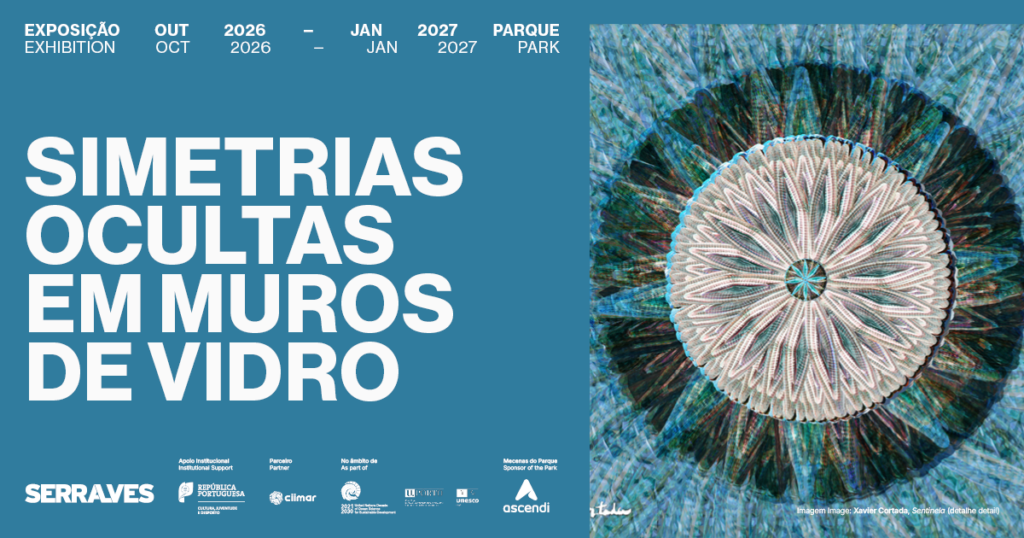
Invisible to the naked eye, diatoms inhabit the threshold between science and art. These unicellular microalgae are enclosed in delicate silica walls, shaped with a precision that echoes stellar geometry. Hidden jewels of diversity, each cell resembles a microscopic stained-glass window, refracting light and sustaining life in aquatic ecosystems. They produce oxygen, sequester carbon and nourish the web of life, silent artisans of planetary balance. The perfection of their patterns reveals a singular beauty, connecting function and form through natural intelligence. As we observe them, the gaze of the scientist merges with that of the artist, both seeking the harmony concealed within living matter. Diatoms remind us that art is not merely a human creation, but an ancient language inscribed in the very structure of the Earth, where each cell is a poem of light and symmetry.
This exhibition invites us on a journey of discovery and understanding of the diatoms found in Serralves Park and around the world, celebrating microscopic worlds of glass and light while revealing their vital role in aquatic ecosystems and their power to inspire. Bringing together the ancient and the contemporary, and bridging scientific rigour with artistic expression, the exhibition reveals how different perspectives across time remind us of the importance of these invisible worlds, inviting us to rediscover the silent beauty that sustains life on Earth.
The exhibition is developed within the framework of the UNESCO Chair Ocean-Expert – Science Education of Children for Ocean Stewardship: in Support of the Sustainable Ocean Economy, at the University of Porto. It is curated by Laura Guimarães and Marina Dolbeth of the Interdisciplinary Centre of Marine and Environmental Research of the University of Porto (CIIMAR), in partnership with the Serralves Foundation – Serralves Park, with Helena Freitas as curator and Marta Tavares as coordinator.
Image: Xavier Cortada, Sentinela, 2026