
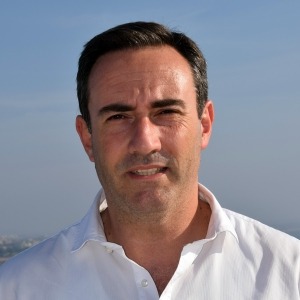
Alberto Teodorico Correia is an Associate Professor with Habilitation at the Abel Salazar Institute of Biomedical Sciences of the University of Porto (ICBAS-UP) and an integrated researcher at the Interdisciplinary Centre of Marine and Environmental Research (CIIMAR), where he leads the Fish Biology and Fisheries team. He is also Director of the Ichthyology Laboratory and the Department of Aquatic Production at ICBAS-UP.
He holds degrees in Aquatic Sciences and Biology, a PhD in Aquatic Sciences, and the Habilitation title in Aquatic Sciences – Biology and Ecology, all from the University of Porto. He has over 20 years of teaching and research experience, having previously held academic positions at Fernando Pessoa University and the University of Trás-os-Montes and Alto Douro.
He served as President of the European Society of Ichthyology and Vice-President of the Iberian Society of Ichthyology, of whose Board he is currently a member. He was also a Special Visiting Researcher at the Federal University of Paraná, Brazil, under the Science Without Borders Programme.
His research focuses on fish biology and ecology. He is internationally recognised for his use of structural, morphological and chemical otolith markers to investigate population structure, migration patterns, habitat use and spatial connectivity in fish. His scientific interests also include fisheries biology and aquatic ecotoxicology, particularly the use of biomarkers to assess the effects of environmental contaminants, including pharmaceuticals, on fish and other aquatic organisms.
He has authored 132 scientific articles published in peer-reviewed international indexed journals and has an h-index of 32 (Scopus). He has extensive experience in coordinating and participating in national and international research projects, supervising undergraduate, master’s and doctoral students, and organising international scientific conferences, including serving as Chair of the Organising Committee.
He serves as an Associate Editor for three international scientific journals and regularly participates in panels evaluating research projects and research grants.
In the past two years (2025 and 2026), he has been included in the World’s Top 2% Scientists list, compiled by researchers at Stanford University (USA) and published by Elsevier. This list identifies researchers with the greatest scientific impact worldwide, based on citation counts and other bibliometric indicators from Scopus.