
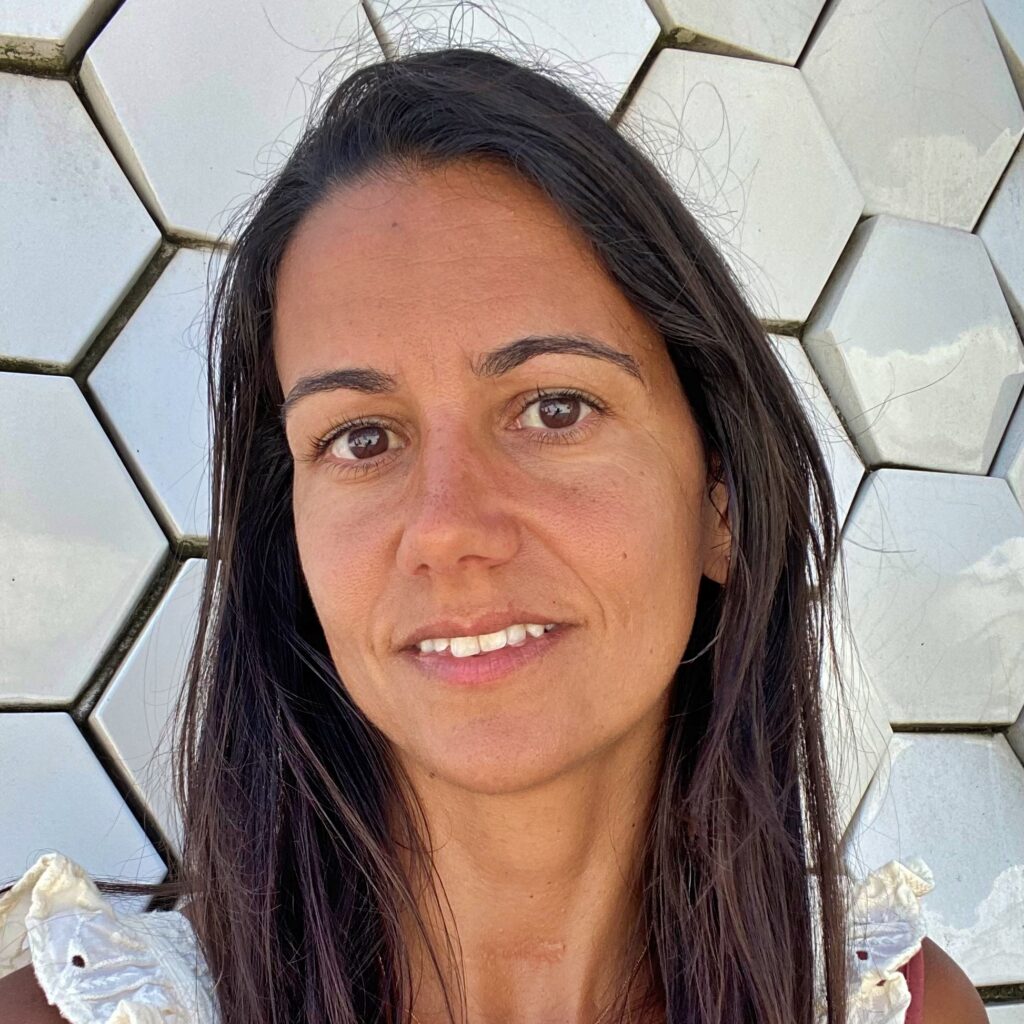
Joana Almeida is Assistant Researcher at CIIMAR, holding a CEEC Ind position, and is the leader of the “Bioinspired Ocean Interfaces” Research Group.
She graduated in Marine Biology (2006, University of the Azores) and received her PhD in Biomedical Sciences (2012) from ICBAS- University of Porto. Her scientific career was consolidated with an individual FCT post-doctoral grant (2013-2017) and a Junior Researcher position at CIIMAR (2018-2022).
Her research interests lie at the intersection of marine biotechnology, ecology, and environmental health. She focuses on exploring bio-based chemical and biological strategies (biomimicry) for biotechnological applications. She aims to develop eco-efficient technologies that rely on environmentally compatible products, which can be applied across various sectors of the maritime industry.

The continuous release of aggressive antifouling (AF) agents into the marine environment has led to significant ecological impacts on marine ecosystems, highlighting the urgent need for more sustainable alternatives. In the context of increasing ocean use by sectors such as aquaculture, shipping, fisheries, mining, and recreation, the development of effective and environmentally compatible biofouling control strategies is essential to support sustainable Blue Growth. Nature offers multiple examples of effective antifouling strategies, as several marine organisms exhibit natural protection against epibiosis. These mechanisms include chemical defenses, production of bioactive metabolites, specific structural and textural surface arrangements, microbial symbioses, and other metabolic processes. Natural compounds such as zosteric acid from eelgrass (Zostera marina) and 6-bromoindole-3-carbaldehyde from coral-associated bacteria, as well as biopolymers like chitosan, alginates, and cellulose found in marine algae and invertebrates, have demonstrated antifouling properties.
The development of new AF technologies inspired by combinations of these natural strategies (bionics) represents a promising pathway for creating effective and biodegradable antifouling materials. Inspired by this concept, the ECOAT project aims to develop ECOlogical bioinspired Antifouling Technologies, including eco-friendly coatings and 3D-printed prototypes, by integrating bioactive natural products with bio-inspired polymeric matrices. This multifunctional strategy combines complementary ecological antifouling mechanisms to enhance both performance and environmental compatibility compared with currently available solutions. The resulting coatings and prototypes are expected to address the needs of multiple industrial applications, including bivalve aquaculture cages, nets, coatings, and paints, while providing innovative solutions for end-users and technology investors.
Beyond developing new materials, ECOAT seeks to understand the ecological mechanisms underlying antifouling performance. Specifically, the project will investigate which combinations of bioactive compounds and biopolymer matrices most effectively prevent biofouling in situ and explore the biological and chemical processes responsible for these outcomes. The project is based on the hypothesis that effective bionic AF materials may select for low-diversity fouling communities that themselves contribute to inhibiting subsequent colonization. Early biofilm formation and fouling communities are influenced by surrounding marine biodiversity but are strongly shaped by the properties of the colonization substrate. The first microbial colonizers can determine subsequent community assembly through chemical cues, including secondary metabolites and macromolecular structures that regulate interactions between microorganisms, benthic organisms, and their environment. However, these modulators remain poorly understood. By analyzing the chemical and biological diversity of early biofouling communities associated with ECOAT prototypes and comparing them with heavily fouled controls and surrounding environmental communities, the project will provide new insights into the molecular and ecological mechanisms driving antifouling processes.
ECOAT brings together complementary expertise through a collaborative framework involving three beneficiary institutions: CIIMAR, with expertise in natural antifoulants, bio-inspired compounds, ecological risk assessment, in situ testing, metabolomics, and high-throughput sequencing; the Faculty of Pharmacy of the University of Porto (FFUP), with expertise in synthetic bioinspired bioactives; and CICECO – University of Aveiro, specialized in biopolymeric materials engineering and 3D printing.
Ultimately, ECOAT will generate innovative scientific knowledge aligned with sustainable development priorities, contributing to the valorization of marine natural resources while delivering environmental and societal benefits.